Book Review & Interview
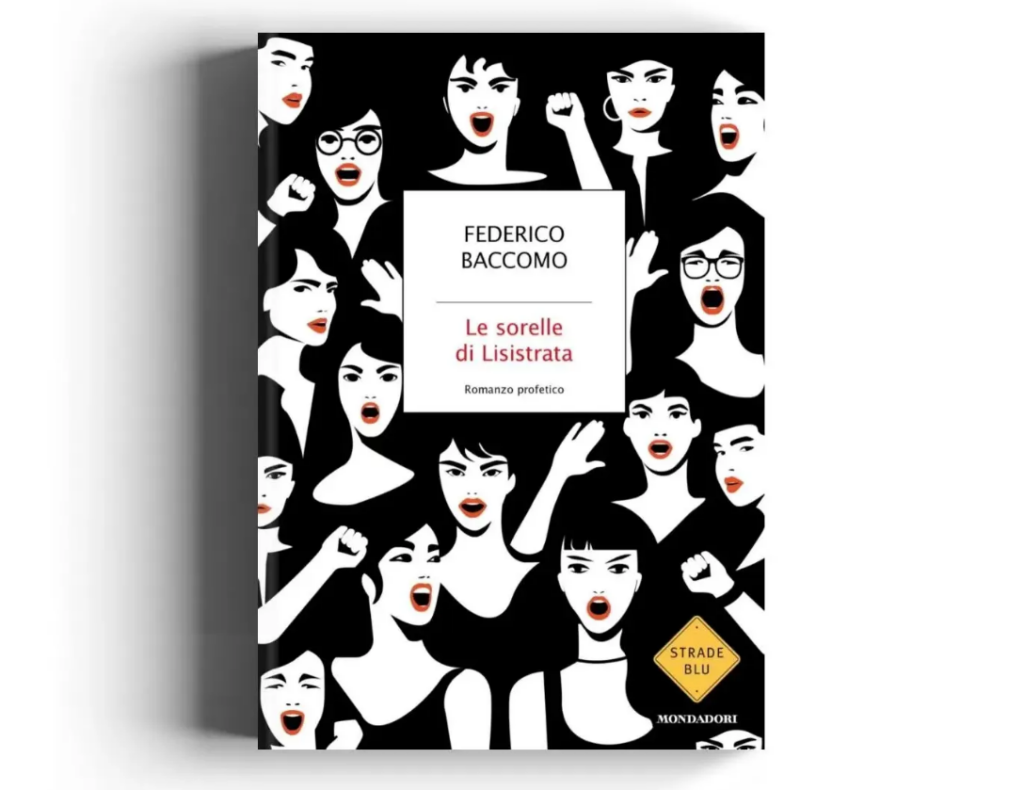
Le sorelle di Lisistrata (2025) and a Conversation with Federico Baccomo
Review and Interview by
Veronica Frigeni, PhD
Visiting Researcher, Center for Transdisciplinary Gender Studies (ZtG), Humboldt-Universität zu Berlin.
| Funding: No funding was received for this research and publication. Conflicts of Interest: The author declared no conflicts of interest. Review History: Received: 18 November, 2025. Published: 28 June 2026. Copyright: © 2026 by the author/s. License: Critical Gender Studies Network (CGSN), India. Distributed under the terms and conditions of the Creative Commons Attribution (CC BY) license (https://creativecommons.org/licenses/by/4.0/). Published by: Critical Gender Studies Network (CGSN) Citation: Frigeni, V. (2026). Le sorelle di Lisistrata (2025) and a Conversation with Federico Baccomo. Critical Gender Studies Journal. 3:1. DOI: https://doi.org/10.21659/cgsj.v3n1.09r |
In a special issue devoted to representations of motherhood, it may seem paradoxical to include the review of a novel that centers on the defense of the freedom not to become a mother. Yet it is precisely in this refusal that some of the most urgent, complex, and politically charged questions about motherhood today are revealed. What if the right to become a mother meant nothing without the freedom not to? In contemporary Italy, where motherhood is increasingly framed by state-driven narratives as “women’s best choice” (Frigeni, 2024), and mobilized as a site of moral surveillance, nationalist nostalgia, and political control, this question is far from abstract. It is urgent, material, and deeply contested.
Feminist and reproductive justice thinkers have long insisted on the crucial distinction between motherhood and mothering (Rich, 1976). Motherhood denotes an institutionalized set of norms and expectations imposed on women by the state, religion, and heteronormative family structures. Mothering, by contrast, is an embodied, relational practice: flexible, self-determined, and potentially subversive. Within the reproductive justice framework developed by Black feminist scholars and activists, especially the SisterSong collective, reproductive freedom entails more than the binary of pro-choice or pro-life: it encompasses the right to have children, the right not to have children, and the right to raise children in conditions of dignity and safety (Ross & Solinger, 2017). Seen in this light, abortion is not an isolated or morally exceptional act, but part of a broader political demand for autonomy, justice, and care. Defending the right to abortion is not in contradiction with mothering; on the contrary, it is what makes chosen, meaningful mothering possible (Frigeni, 2025).
Over the past thirty years, Italian politics has increasingly operated under what Hanafin (2007) describes as a regime of “vitapolitics,” a mode of governance not aimed at empowerment, but rather at confining women within a constructed “natural” order that privileges pro-natalist, pro-family agendas. Within this framework, abortion is tolerated only as an exception, not affirmed as a right. Although the passing of Law 194 in 1978 represented a landmark achievement, many Italian feminists have long critiqued its limitations. The law emerged from a fraught compromise among diverse actors – feminist movements, leftist parties, and the Catholic Church – and, crucially, it failed to spark the deeper cultural transformation around gender, sexuality, and bodily autonomy that many had hoped for. As a result, legal access to abortion has coexisted with enduring stigma, moral judgment, and institutional resistance. This is why contemporary feminist campaigns often insist on going “much more than 194” (Frigeni, 2025), calling for a reproductive justice approach that can address the broader intersection of legal, social, and cultural forces shaping women’s reproductive lives. In the Italian context, material obstacles to reproductive care are entangled with dominant discourses that frame motherhood as a woman’s natural destiny and abortion as an inherently violent, traumatic act, thus reinforcing a biopolitical system in which female bodies are governed through moralization rather than freedom.
To resist paternalistically imposed motherhood, then, is to create space for reproductive agency in all its forms. And it is precisely this space that Le sorelle di Lisistrata (Lysistrata’s Sisters), Federico Baccomo’s bold and unsettling novel, seeks to imagine and defend. Set in a disturbingly plausible near-future Italy, the novel begins with a moment of political manipulation: Piergiuliano Berton, the newly appointed Minister for the Family in a right-wing government, publicly recounts the heartbreak of a long-past abortion experience: an anecdote that later proves to be a fabrication. Yet its emotional weight is enough to ignite media frenzy and prepare public opinion for what soon follows: the repeal of Law 194 and the approval of the “Law of the Good Life,” which criminalizes abortion in all forms, at any stage, and for any reason. Enter Gaia Zavattini: 27 years old, newly elected in the ranks of a weakened center-left coalition, and a scholar of classical antiquity. Shocked by the new law and disillusioned by the inertia of traditional political channels, Gaia impulsively posts a reference to Aristophanes’ Lysistrata on Instagram, suggesting that women today, like their ancient Greek counterparts, might use a sex strike to resist patriarchal violence. The idea, half-serious and half-desperate, catches fire. Under the viral hashtag #lesorelledilisistrata (#lysistratassisters), women across the country begin to share their stories, frustrations, and support, transforming Gaia’s isolated protest into a national movement.
Baccomo’s novel deftly combines speculative fiction and biting political satire with contemporary themes, making it both timely and prophetic. At its core, the novel interrogates the weaponization of pro-life and pro-family rhetoric, a central axis of current far-right discourse, not as neutral values, but as tools for dismantling women’s autonomy (D’Elia & Serughetti, 2021). The new legislation is portrayed not only as a regression in women’s rights, but as an outright reconfiguration of “reproductive citizenship” (Shaw, 2022), wherein the value of female bodies is strictly determined by their maternal potential. The novel also explores the layered dynamics of contemporary feminist activism, online and offline (Salvatori, 2023). Gaia’s accidental leadership illustrates the unpredictability of digital resistance, where a post can spark collective mobilization as easily as it can provoke backlash, trolling, and character assassination. As the novel progresses, Gaia becomes the target of relentless public scrutiny and a process of systematic stigmatization and “monsterization” (Compagna & Steinhart, 2020), which speaks to abortion as a still “societal taboo” in today’s Italy and to the (non)reproductive body as the implosion of a system of order and rightness (p. x). Cast as the archetype of the “unruly woman” and reduced to what O’Reilly-Collin and O’Reilly (2025) have termed a “feral body,” she is vilified in increasingly violent and gendered ways. This demonization reaches its peak when she is scapegoated for the deaths of several women during a street protest, an event she neither incited nor controlled. Her credibility is dismantled, her intentions distorted, and her femininity subjected to constant surveillance and correction. Through this portrayal, Baccomo incisively captures the ways in which contemporary feminist dissent is often reframed as a “war of the sexes” (McRobbie, 2009), a depoliticizing narrative that turns structural critique into personal antagonism, and erases the political stakes of reproductive resistance. The sex strike, in this context, becomes a deliberately provocative feminist tactic, not merely a symbol of sexual power, but a refusal of the very terms on which heteronormative, patriarchal intimacy is built.
Stylistically, Le sorelle di Lisistrata positions itself as a “prophetic” novel, although not in the sense of a distant, dystopian fantasy, but as an unsettlingly plausible extrapolation of contemporary Italy. Baccomo appropriates the conventions of speculative fiction not to escape the political present, but to expose its underlying logics and trajectories. His narrative traces the slow erosion of reproductive rights, the convergence of authoritarian populism and religious conservatism, and the affective manipulation of trauma in public discourse. In this sense, the novel functions both as speculative fiction, defined by Oziewicz (2017) as fiction that departs from “consensus reality” to mirror the present through its logical, if alarming, consequences, and as part of the longer feminist dystopian tradition (Norledge, 2022), which uses imagined futures to critique gendered power structures. Yet Baccomo’s work also departs from this lineage: rather than constructing a radically unfamiliar dystopia, Le sorelle di Lisistrata operates as a form of counterfactual realism, a speculative scenario that remains deeply tethered to the affective climate and political logics of contemporary Italy. What makes the novel particularly powerful is its capacity to expose, resist, and imagine alternatives to what Micciché (2025) has termed “patriarchal realism”: the narrative regime through which gendered oppression is rendered natural, inevitable, and thus unquestionable. Drawing inspiration from Fisher’s (2009) notion of “capitalist realism” – the idea that it is easier to imagine the end of the world than the end of capitalism – Micciché suggests that patriarchal realism functions similarly, conditioning our perception of gender norms as immutable facts rather than socio-political constructs. Baccomo’s novel unsettles this narrative closure, insisting instead on the possibility of rupture, refusal, and reinvention. Nonetheless, these very cracks in the system, while gesturing toward alternative futures, also expose bodies and lives to renewed forms of risk. In Le sorelle di Lisistrata, resistance is neither safe nor romanticized: it entails a politics of exposure, where stepping outside the normative frame – whether through dissent, solidarity, or refusal – often invites surveillance, backlash, and violence. The novel thus confronts us with a double bind: it illuminates the urgent need for alternative imaginaries, while refusing to conceal the material cost of sustaining them
This is why I argue that, in a world increasingly governed through biopolitical regimes, where power is exercised through the regulation of life itself, Baccomo’s novel turns to what Foucault, in a rare note, described (2017) as “biopoetics”: a mode of resisting normalization through aesthetico-ethical self-fashioning. To move beyond biopolitics, Foucault argues, the regime of truth that underpins it must be exposed, its contingency made visible, its fractures situated within both individual subjects and the knowledge-power matrices that govern them. In this regard, Le sorelle di Lisistrata opens up a “future anterior” horizon (Higgins & Leps, 2022), which is less a prediction than a provocation: what might we yet become if we refuse the present’s reproductive imperatives? The novel, then, functions as a “heterotopias” in the Foucauldian sense (1986), not merely a fictional setting, but a counter-site that reveals the artifice of dominant norms around gender, family, and political agency. Through three interwoven processes, “disposition, distraction, and dislocation” (Higgins & Leps, 2022), Baccomo disorients the reader to create critical distance. It disposes us to transpose: by staging a familiar-yet-altered Italy where abortion has been criminalized, it forces us to reconsider the precariousness of reproductive rights in our own reality. It distracts in the etymological sense of pulling away, allowing for transactions between disparate systems of meaning: classical mythology, feminist genealogy, social media activism, mass media and the machinery of the state. And it dislocates, exposing the constructedness of so-called truths, such as the sanctity of family, the inevitability of motherhood, the neutrality of law. This is not merely narrative dislocation, but ontological: the novel enacts biopoetics as a way of imagining and inhabiting alternative forms of life.
Gaia Zavattini, the novel’s protagonist, enacts this counter-practice through a form of “parrhesia,” which is Foucault’s term (1983) for courageous, risk-laden truth-telling. Her initial social media post is neither strategic nor calculated; it is an impassioned, unfiltered response that catalyzes collective resistance. Gaia’s speech defies institutional decorum; it is direct, affective, and politically dangerous. Her trajectory, from idealistic scholar to activist to victim of state and sexual violence, illustrates the cost of parrhesia in a system that disciplines women not only through law but through the moralized expectations of maternal sacrifice. Her rape and subsequent pregnancy signal the violent backlash against women who transgress the normative reproductive script. Yet Gaia’s ultimate withdrawal from public life, even after the law is repealed, should not be misread as defeat. Rather, it affirms her refusal to be co-opted, whether as a symbol of resistance or a martyr of the cause. In choosing exile over appropriation, Gaia asserts a quieter but no less radical form of agency: the refusal to play the role assigned by power, even when that role is one of triumphant dissent. It is precisely this refusal that embodies the ethical force of parrhesia, not as heroic display, but as the insistence on truth-telling at the price of belonging.
Similarly, the sex strike at the heart of Le sorelle di Lisistrata can be understood not merely as a symbolic gesture of protest, but as a collective act of parrhesia, of truth-telling through embodied refusal. Foucault emphasizes that the decisive trait of the parrhesiast lies not in birth, class, or rhetorical mastery, but in the coherence between one’s speech and one’s way of life. In this sense, Gaia and the women who join her do not simply speak against the “Law of the Good Life”; they perform their dissent through the radical interruption of the intimate and reproductive labor the state assumes to be theirs. The strike functions as a materialization of “logos-bios” alignment (Higgins & Leps, 2022): the women’s bodies become the medium through which truth is articulated, not just stated. In withholding sexual and emotional availability, they render visible the invisible infrastructures of power that condition women’s social roles under the guise of naturalized femininity. This embodied refusal does not require institutional authority to be legible as political; rather, it draws its force precisely from the ethical risk of standing apart from what is expected, proper, or safe. In Foucauldian terms, this form of protest is parrhesiastic because it exposes the vulnerable body to scrutiny and retaliation, while remaining faithful to a truth that exceeds personal interest. The strike thus becomes a site of truth-practice, where speech, risk, and life converge into a shared act of political becoming.
In this light, Le sorelle di Lisistrata contributes meaningfully to contemporary feminist and reproductive justice debates by insisting that the right not to mother is inseparable from the ability to mother freely and meaningfully. The novel does not position abortion as a tragic exception to maternal desire, but as part of a wider continuum of reproductive agency. By foregrounding the affective, bodily, and political dimensions of refusal, Baccomo’s novel helps reframe reproductive rights not as narrow legal entitlements, but as relational, embodied, and ethically fraught forms of world-making. In doing so, it challenges readers to recognize reproductive freedom as not just a private choice, but a public, collective stake, a terrain where the intersectional struggle for justice, dignity, and alternative futures is continuously unfolding.
A Conversation with Federico Baccomo
In light of the preceding discussion, I had the opportunity to speak with Federico Baccomo, whose novel Le sorelle di Lisistrata offers a bold and unsettling fictional intervention into the ongoing discourse on reproductive politics in Italy. The following questions aim to explore how Baccomo understands the political stakes of his work, its mythopoetic dimensions, and its engagement with the epistemic and affective landscape of the present.
- VF: Your novel unfolds as a narrative work that, while fictional, deeply engages with the socio-political anxieties of contemporary Italy, touching on issues such as gender, reproductive rights, and the often porous boundaries of political and institutional power. As Foucault (1977) observed, a book cannot be reduced to the subjective truth of its author; rather, it constitutes a fiction that reflects the broader epistemic configuration of its era. To what extent do you see Le sorelle di Lisistrata as shaped by the “regimes of truth” of our present, particularly in relation to the restriction of reproductive citizenship, the politicization of women’s bodies, and the sexualization and punishment of dissent? Do you view the novel as a potential “epistemological document” of the present, or rather as a speculative narrative aimed at destabilizing the now through projection into the future? Finally, what role does your own authorial positionality play in this tension between chronicling and foretelling?
FB: Before answering such a complex question, I need to preface my response by clarifying what novels are to me, at least at the moment they are conceived. They are stories. Nothing more, nothing less. They are not reflections, nor philosophical elaborations, nor vehicles for a message. They are – if I may simplify – a character who wants something and, in order to obtain it, must overcome a series of obstacles. Odysseus wants to return home despite the will of the gods. Edmond Dantès wants revenge against a long list of enemies. Renzo and Lucia want to get married in spite of the opposition of a powerful tyrant. Novels are born from these narrative sparks with which writers attempt to kindle a fire, that is, to develop a compelling plot (whatever meaning we wish to assign to “compelling”: a Patricia Highsmith thriller can be as compelling as a Virginia Woolf novel). The plot – a word that nowadays seems to frighten a good percentage of writers, as if it were a stain from which literature must cleanse itself but doesn’t know how – is the foundation of a good book. It answers the question: What is this novel about? Then, at a later stage, during the writing process, something more begins to emerge from the pages, something that some call “the theme.” The theme, indeed, is a reflection, a philosophical elaboration, a message. It answers a different question: What is this novel really about? This is a discovery made by the reader while reading, but it is also a discovery made by the writer while writing. Conversely, if a writer were to sit down with a preconceived doctrine – for example, “the rich are all bad” – and tried to disguise it within a story, not only would the novel be suffocated by a theme that blocks any free development of thought (that very freedom which makes thought fertile), but we would be faced with a servile novel, incapable of revealing anything new about the world, and thus, an empty one. These are the so-called thesis novels, to which even the most brilliant writers have sometimes succumbed (I’m thinking of an exceptional author such as George Orwell and his Animal Farm).
Having made this long (and perhaps pedantic) preamble, I can say that Le sorelle di Lisistrata was born simply from the encounter of two ideas. One stolen from reality: what would happen if Italy, following the American example after the overturning of the Roe vs. Wade decision, were to ban abortion? And another borrowed from imagination: what would happen if, in protest against this ban, a woman were to follow Aristophanes’ Lysistrata and call for a sex strike? The meeting of these two ideas seemed to me narratively explosive: here was a novel I would have liked to read and/or write.
At that point, it became a question of deciding the narrative perspective: who would tell such a story? Perhaps the protagonist? Perhaps an omniscient narrator? I wrestled with this for quite some time, and eventually found what seemed to me the most fitting perspective: that of a reporter. What if I wrote the novel as if it were a long, cold piece of reportage? The option made sense on several levels: first, it lent the story a certain degree of realism; second, it allowed me to adopt a stripped-down, journalistic style, giving me the chance to play with the quirks and distortions of that language; but above all – and here we finally reach the answer to your question – it allowed me to hide. I could make the author disappear from a novel that, on almost every page, demands that one take sides, that one express a moral and ethical judgement. In this sense, the novel tries to be a faithful mirror of our time, seeking to construct a story as plausible as possible, starting from its premise (the two ideas above), and developing it through a rigorous chain of narrative cause and effect until its final explosion. Thus – at least it seems to me – the balance and tension you refer to between (to use perhaps overly simple words) reality and fiction are not so much erased (which would be impossible) as somehow circumvented, at least formally, allowing me, the author, to step aside. Not to evade my responsibilities, but to allow the novel to live on its own, without being crushed or nullified by my own positions.
- VF: Giorgio Agamben (2009) defines the “contemporary” as “that relationship with time that adheres to it, through a disjunction and an anachronism” (p. 41); at the same time he observes how, the contemporary is not one who merely inhabits their time, but also and mostly one who turns toward its darkness, not to lament, but to perceive the light that struggles to reach us. Your novel imagines a future Italy in which reproductive rights are dismantled, dissent is criminalized, and political storytelling becomes a tool of manipulation. In this sense, the novel embodies Agamben’s idea of the contemporary by illuminating the obscurities of the present through prophetic realism. But following his formulation, I would also ask: where do you locate the flickers of light in this darkness? Are there forms of resistance, care, or solidarity in the novel that point toward alternative futures – even if fragile, fragmented, or unresolved?
FB: I have always rejected that somewhat snobbish idea of literature that insists it must shock, unsettle, or disturb. Life itself already throws plenty of punches; I have no wish to join in the existential bullying with my stories. For this reason, I believe that it is not, perhaps, necessary, but certainly desirable, for a novel, even the darkest, cruellest, most merciless one, to contain at least a seed of light. Or better still: several seeds of light. In Le sorelle di Lisistrata, darkness reigns from the very first pages. And it is a darkness destined to grow ever denser, at times unbearable; it often seems impossible to glimpse even a glimmer. Yet I have the feeling that, by the end of the book, however angry, or even furious, the reader might feel, they do not come away despairing. And I believe this is thanks to her, Gaia, the protagonist.
Gaia is a resilient woman, one who does not give up; a young woman who, despite her sense of inadequacy, keeps her protest alive. From the moment she steps onto the page, Gaia carries within her a sense of hope, not so much that everything could be different, but that everything must be different. She is the light, mine and the novel’s: the affirmation of a will that, despite everything, refuses to bend. What comforts me is that Gaia does not seem to me merely a narrative device. I continue to see voices and wills like hers around me, and even though at times – and increasingly often – they appear to be in the minority, or worse, powerless, they remain alive. Often, far more alive than those who speak only of darkness.
- VF: Your novel does more than reference Aristophanes’ Lysistrata; it reanimates the myth as a feminist and strategic resource within a contemporary media ecology. Gaia’s invocation of the sex strike becomes a viral, affective force that transforms private trauma into public action, blurring parody, tragedy, and revolt. In this sense, the novel uses myth not as nostalgic return, but as what Chiara Bottici (2021) might call a “mythopoetic” tool: a way to imagine otherwise, perform dissent, and reframe dominant narratives. As Bottici writes, “Myths are self-fulfilling prophecies: they do not wait for reality to prove their truth—they build it. […] A myth must constantly reinvent itself to remain alive, responding to ever-changing conditions of meaning” (p. 3). How do you understand the role of Lysistrata in your novel? Do you see Gaia and the women who follow her as mythmakers in their own right, creators of a counter-myth capable of disrupting dominant narratives of nationhood, morality, and motherhood?
FB: Writing a novel is a journey that spills beyond the pages. It involves studying, delving deeper, investigating: sometimes, to write a single line, one may have to go through hundreds of pages, or films, or conversations. During this journey, one of the discoveries I made was that my protagonist was not inventing anything new. The so-called “Lysistratic non-action” (that is, the sex strike first imagined by Aristophanes in Lysistrata) is a form of non-violent protest that women, at different times and in different contexts, have repeatedly turned to throughout history. I discovered that the myth had become reality, and that my story, without my even realising it, drew its strength not so much from the imagination of the Greek playwright as from its embodiment in the real protests of women who had actually done it. Indeed, to truly do it – to reinvent the myth in response to one’s own time and aspirations – is the best way to ensure that once upon a time may last forever after. Gaia and her sisters, in fiction, try to do just that: not only by attempting to dismantle dominant narratives, but above all by making themselves the protagonists of the narrative, to the point where they can no longer be ignored. In Aristophanes’ Lysistrata, the protagonist’s strength lay precisely here: not merely in having proposed a sex strike, but in having made it impossible to ignore her words, her protests, her demands.
- VF: The novel vividly illustrates how collective fear and manufactured emotion can solidify into what has been described as a “pyramid of hate” (Faloppa & Gheno, 2021) – a process through which everyday microaggressions rest upon, and contribute to, deep-rooted structures of systemic violence. In Le sorelle di Lisistrata, hate operates not only as a visceral emotion, but also as a rhetorical tool and a political technology: it is cultivated by media narratives, weaponized by institutions, and normalized within public discourse. Following Ahmed’s analysis (2004), hate can be understood as a cultural and affective mechanism that aligns subjects against imagined threats, producing boundaries between those who belong and those who must be expelled. How did you conceptualize the role of hatred in constructing this fictional world? In your view, is hate merely a byproduct of authoritarian populism, or does it function as its true affective engine? And crucially, do you consider this hatred to be gendered – both in the way it is directed and in how it is legitimized? Does the novel suggest that women – particularly those who resist normative roles—become symbolic targets of a broader cultural anxiety around social change? How do you see the interplay between fear, misogyny, and the desire for moral control operating within your narrative?
FB: Hatred is one of the main driving forces of the novel, because unfortunately it seems to have become one of the main driving forces of society – especially today’s media society. It is a hatred that manifests itself in numerous forms: there is the polarisation that social media and the speed of expression have imposed on us – “You’re either with us or against us!” – leaving no room for nuance, for reflection; there is the habit of hatred, born from the ease with which we can now resort to insult without any consequence (the notorious “keyboard warriors”); there is the hatred that is stimulated by algorithms, which benefit from exposing us to content we disagree with, since our attention – driven by anger – is far more easily awakened by what infuriates us than by what we agree with; there is hatred used as a tool of delegitimisation: anyone who expresses an opinion contrary to mine is an “hater”, and must be treated as such; and many other forms of hatred could be identified. Thus hatred becomes the nerve of a system that feeds on it and does nothing but fuel it further. And who are the main victims? Precisely those who choose to step outside the norm. In this sense, women – especially those who assert themselves beyond a rooted and obsolete vision – are the natural targets of a large segment of society (composed of both men and, unfortunately, also women) which – particularly on sexual matters (in the broadest sense) – feels not so much challenged as outright victimised by what it perceives as a profound lack of respect: how dare you question the established order?! Thus fear – because ultimately these people are often frightened (dangerous, but frightened) – turns into an anxiety to restore the lost order, with all the violent consequences this may entail.There is a rather stark passage in the novel, in which Gaia suffers the worst kind of violence as a form of punishment, and I believe that the criminals who commit that violence are neither ironic nor looking for a pretext: no, they genuinely believe themselves to be invested with that mission. The most terrible kind of hatred: ideological hatred, which absolves itself.
- VF: Le sorelle di Lisistrata presents a media ecosystem where emotional manipulation, spectacle, and strategic framing play a central role in shaping public perception and institutional power. From the Minister’s fabricated abortion story to the viral spread of Gaia’s protest, the novel highlights how media not only mediate political reality but actively construct it. In conceptualizing this dimension, to what extent were you influenced by theories of media effects which argue that media shape not only what we think about, but how we interpret and value it? More specifically, how do you see the role of media in reinforcing cultural scripts around gender and motherhood in Italy? And what possibilities, if any, do you see for media to foster counter-narratives that resist consensus and open space for reproductive dissent?
FB: The media – especially social media, in the worst version of a series of algorithms owned by a handful of ultra-millionaires who, outside any form of regulation, decide the topic of the day, promoting what they think should be promoted and concealing what they think should be hidden – are our modern Scheherazade: they tell the stories, and we are captivated. But Scheherazade – the original one – not only declared her fiction, she also had a noble purpose: to save women like herself, victims of the hatred (there it is again) of a deranged ruler. What is the purpose of today’s media? First and foremost, to enrich investors. But not only that. It has now become clear that controlling public opinion is among their principal objectives. For this reason – in a novel that speaks of entire peoples in mobilisation – it was impossible to detach the narrative from something as apparently unliterary as the media. Specifically, gender and motherhood are arenas on which the future of politics and society is now being played out (these are issues that move people more than economic crises, environmental crises, even war). Allowing the narration of such sensitive matters to be outsourced to those aforementioned multimillionaires, who possess the power to control (and censor) whatever does not fit within their personal agenda, represents a dangerous frontier, one in which no one – in the few expressive spaces they may manage to carve out (as Gaia does in the novel) – stands any real chance of winning. The only solution I can see is to regulate those spaces, removing them from the self-governance of private entities: in short, there can be no Zuckerberg, no Musk, who holds the freedom and the power to decide who may speak, about what, when, and how – even if that means killing whatever algorithm drives the delivery of content.
- VF: In one of the most emotionally charged scenes of the novel, Gaia stands before Parliament and utters six words – “I’m pregnant. I don’t want to keep it” (p. 109) – that the narrator describes not only as personal declarations, but as questions that the Italian public feels compelled to answer. These statements, though uttered in the first person, are received as collective provocations. You write: “All that remained of her was the deafening uproar of those six words. I’m pregnant. I don’t want to keep it. Two statements that were also a question that Italians felt compelled to answer. Forced to answer. How else could they go on?” (p. 142). The novel powerfully stages the way personal reproductive experiences are transformed into public moral battlegrounds. How did you envision this scene, in which a survivor’s trauma is not met with empathy or care, but becomes a national referendum on motherhood, agency, and belonging? Do you see this moment as a commentary on how Italy’s cultural and political discourse routinely appropriates women’s bodies as symbols for broader ideological conflicts?
FB: More than a critique, it is an accusation. Democracy – that famous lesser evil – is not a goddess to whom everything must be sacrificed. There are aspects of life that must be removed from the decision of the majority. Let’s make a hypothesis: tomorrow the country wakes up and decides to establish a lottery in which, once a year, someone is chosen by lot to be stoned to death (the idea, of course, comes from Shirley Jackson). Is that legitimate? According to the most rigidly democratic logic, if that is what the majority wants, the answer is: yes. Yet we all feel, instinctively, that it is an aberration. So why is it that, when it comes to deciding over a woman’s body, the issue is elevated to a political question – as though this ennobled the debate – when in fact it concerns an invasion that should be removed precisely from that debate? In this sense, the scene in the book becomes a question not only for the Italian people within the novel, but also for the reader outside it.
- VF: Le sorelle di Lisistrata engages directly with some of the most urgent debates of our time: on reproductive rights, gendered violence, and the politicization of women’s bodies. Yet it does so not through didacticism, but through a complex and emotionally charged narrative form.
What do you hope the novel contributes to these ongoing conversations, not only in terms of its thematic content, but also through its formal, ethical, and political approach to storytelling?
Why do you think this kind of narrative intervention is needed now, in this particular historical moment? What role can fiction play in unsettling dominant discourses, making visible what is often silenced, or offering new affective and imaginative vocabularies for resistance?
In short, how do you see your work positioning itself, artistically and politically, within the broader cultural struggle over meaning, resistance, and agency?
FB: I am very cautious about assigning a social mission to literature: my fear is that a tool for analysis, investigation, and discovery might become a tool for propaganda (even when the ideas being promoted are worthy ones). I am convinced that the usefulness – political or social – of a novel is a marvellous side effect, which occurs when the author tells a story that engages honestly and intelligently with the present. When that happens, something precious takes place: the reader has the chance to travel through imagination into worlds that broaden their vision of reality, and in this sense they are able to amplify that quality so central to the act of reading: empathy. It is in this sense that a good book can – if I may use an overused phrase – “change the reader’s life”, just as a journey, a conversation, a love affair, or indeed any experience that widens our perspective can. For this reason, it is not wrong to speak of agency in relation to books: we approach them seeking comfort, pleasure, entertainment (for these are, for the most part, the driving forces behind reading), and we part from them having gained a new awareness, one that is capable of guiding our actions.
References
Aristophanes. (1994). Lysistrata (D. Parker, Trans.). Dover Publications. (Original work published ca. 411 B.C.E.).
Agamben, G. (2009). What is an apparatus? And other essays. Stanford University Press.
Ahmed, S. (2004). The cultural politics of emotion. Edinburgh University Press.
Baccomo, F. (2025). Le sorelle di Lisistrata. Mondadori.
Bottici, C. (2021). A feminist mythology. Bloomsbury Academic.
Compagna, D., & Steinhart, S. (2020). Monsters, monstrosities, and the monstrous in culture and literature. Vernon Press.
D’Elia, C., & Serughetti, G. (2021). Libere tutte: Dall’aborto al velo, donne nel nuovo millennio. Minimum Fax.
Faloppa, F., & Gheno, V. (2021). Trovare le parole: Abbecedario per una comunicazione consapevole. Edizioni Gruppo Abele.
Fisher, M. (2009). Capitalist realism: Is there no alternative? Zero Books.
Foucault, M. (1977). What is an author? In D. F. Bouchard (Ed. & Trans.), Language, counter-memory, practice: Selected essays and interviews (pp. 113–138). Cornell University Press.
Foucault, M. (1983) Discourse and truth: The problematization of parrhesia. The University of California, Berkeley.
Foucault, M. (1986). Of other spaces. Diacritics, 16(1), 22–27. https://doi.org/10.2307/464648
Foucault, M. (2017). Subjectivity and truth: Lectures at the Collège de France, 1980–1981 (G. Burchell, Trans.). Palgrave Macmillan.
Frigeni, V. (2024). Il lato oscuro della maternità: Il femminismo di Eugenia Roccella. gender/sexuality/italy, 10(1–2), 50–67.
Frigeni, V. (2025). Therapeutic abortion narratives in contemporary Italy: A mothering, feminist, and political choice. In B. Boudreau & K. Maloy (Eds.), Abortion in international popular culture: The decision heard round the world (pp. 105-132). Bloomsbury Academic.
Hanafin, P. (2007). Conceiving life: Reproductive politics and the law in contemporary Italy. Ashgate.
Higgins, L., & Leps, M. C. (2022). Heterotopic world fiction: Thinking beyond biopolitics with Woolf, Foucault, Ondaatje. Academic Studies Press.
Jackson, S. (1949). The lottery and other stories. Farrar, Straus and Company.
McRobbie, A. (2009). The aftermath of feminism: Gender, culture and social change. SAGE.
Miccichè, M. (2025). Realismo patriarcale. Come il sistema ci educa alle diseguaglianze. Einaudi.
Norledge, J. (2022). The language of dystopia. Palgrave Macmillan.
O’Reilly-Conlin, C. J., & O’Reilly, A. (Eds.). (2025). Gone feral: Unruly women and the undoing of normative femininity. Demeter Press.
Oziewicz, M. (2017, March 29). Speculative fiction. Oxford Research Encyclopedia of Literature. https://oxfordre.com/literature/view/10.1093/acrefore/9780190201098.001.0001/acrefore-9780190201098-e-78
Orgwell, G. (1945). Animal Farm. Secker & Warburg.
Rich, A. (2021). Of woman born: Motherhood as experience and institution. W. W. Norton & Company. (Original work published 1976)
Ross, L. J., & Solinger, R. (2017). Reproductive justice: An introduction. University of California Press.
Salvatori, L. (2023). Artivism as transformative practice: The case of Non Una Di Meno. In D. Lisle (Ed.), Research handbook on visual politics (pp. 138-151). Edward Elgar Publishing. https://doi.org/10.4337/9781800376939.00018
Shaw, R. M. (2022). Reproductive citizenship: Technologies, rights and relationships. Palgrave Macmillan.