Review and Translation
Poetry That Bites: Stefania Antonelli’s Fragments of a Maternal Becoming
Perrone, 2025, 978-8860047724
Review and Translation
Stefania Antonelli and Veronica Frigeni, PhD
1Independent Scholar
2Visiting Researcher, Center for Transdisciplinary Gender Studies (ZtG), Humboldt-Universität zu Berlin
| Funding: No funding was received for this research and publication. Conflicts of Interest: The author declared no conflicts of interest. Review History: Received: 15 September, 2025. Published: 28 June 2026. Copyright: © 2026 by the author/s. License: Critical Gender Studies Network (CGSN), India. Distributed under the terms and conditions of the Creative Commons Attribution (CC BY) license (https://creativecommons.org/licenses/by/4.0/). Published by: Critical Gender Studies Network (CGSN) Citation: Antonelli, S. & Frigeni, V. (2026). Poetry That Bites: Stefania Antonelli’s Fragments of a Maternal Becoming . Critical Gender Studies Journal. 3:1. DOI: https://doi.org/10.21659/cgsj.v3n1.10t |
“Motherhood is the last frontier of female writing”: this bold claim opens Alice Braun’s recent study on maternal authorship, framing motherhood not as a topic among others, but as a profound challenge to traditional understandings of selfhood and literary creation (p. 2). In the last two decades, as Braun (2025) observes, literature, particularly life writing and poetry, has seen a significant rise in narratives that center the maternal not only as a theme but as a form and process. These texts not only portray mothers; they attempt to become maternal in their very structure: fragmentary, interrupted, relational. Motherhood meaningfully destabilizes the liberal ideal of the self-contained individual. The maternal self is defined through relation: fluid, incomplete, and shaped by others’ needs. This relational identity often clashes with dominant models of artistic authorship that prize detachment, autonomy, and control. It’s in this tension that maternal writing gains its force: it becomes a space where the “impossible subject” of the mother can begin to speak in her own terms (Braun, 2025). Rather than presenting a coherent narrative arc, many of these texts – memoirs, journals, hybrid essays, poems – embrace fragmentation, repetition, and interruption as structural principles, reflecting the lived realities of care and constraint.
As Braun (2025) observes, when women become mothers, their relationship to time and space is fundamentally altered, along with their place in the world and their connections to others (p. 133). Maternal life introduces temporal ruptures, emotional intensities, and shifting priorities that complicate linear or unified narratives. In this sense, writing motherhood often demands new forms: discontinuous, intimate, and hybrid. Poetry becomes a privileged space for this exploration: a genre that accommodates fragmentation, brevity, and embodied rhythms. Philosopher Lisa Baraitser (2008) offers a powerful account of how maternity disrupts conventional narrative logic. She describes the maternal subject as “a subject of interruption” (p. 74), whose time is perpetually fractured by the child’s needs. This disruption challenges the very conditions of literary production, particularly for mother-writers, who must contend with a genre, a narrative, that presupposes continuity. For Baraitser, “motherhood lends itself to anecdote rather than the grand narrative of ‘mother-writing’ due to the constant attack on narrative that the child performs” (p. 15). Writing becomes an act negotiated in the interstices of care, shaped by delay, pause, and return.
Literary critic Sarah Blackwood (2018) expands this reflection by suggesting that motherhood should be considered not merely a subject, but a genre, a material practice that shapes writing itself. In this view, motherhood is not something a writer chooses to address or not, but an embodied condition that restructures writing from within. As she puts it, writers such as Maggie Nelson and Jenny Offill exemplify how the formal fragmentation of their texts mirrors the discontinuous rhythms of maternal time: “motherhood is nothing but a collection of short bursts of focus set inside the oceanic nothingness of time passing.” The genre of motherhood, then, is marked by narrative interruption, temporal compression, and structural openness.
In life writing, this formal innovation aligns with a feminist shift from daughter-centric narratives to matrifocal ones. Elizabeth Podnieks and Andrea O’Reilly (2010) argue that contemporary maternal texts work to reclaim the mother’s voice and subjectivity. These writings reject idealized or culturally imposed images of the selfless, ever-giving mother in favor of honest, at times ambivalent, representations of care, exhaustion, and resistance. As Podnieks and O’Reilly explain, such matrifocal texts allow women to resist the symbolic erasure of motherhood and gain narrative control over their lived realities (p. 7). In this process, they seek to tear off what Susan Maushart (1999) has famously called “the mask of motherhood.”
Taken together, these perspectives invite us to think of maternal poetry, and specifically of Stefania Antonelli’s poems, not as a niche category, but as a vibrant and evolving form of life writing that grapples with the constraints and affordances of mothering as both experience and practice. Her poetry does not reflect on motherhood from a distance; it is written within it, amid fatigue, love, repetition, rupture, and intimacy. It is poetry shaped by time “borrowed” from care work, marked by the laboring maternal body and the unfinished rhythms of daily life. In this sense, maternal writing is not only personal and political: it is formally radical. This fragmentary poetics is central to the work of Italian poet Antonelli, who begins from the premise that “the fragment is the form of experience itself… as if only through the fragment could the chaotic truth of motherhood be told.” For Antonelli, poetry does not speak about motherhood from a distance, but emerges within it, rooted in the everyday fatigue of the body that nurses, yields, gets dirty and cleans, resists. From this deeply embodied and immersive position, her maternal poetics disrupt conventional notions of voice, authorship, and form.
A second defining feature of Antonelli’s work is her marked use of corporeal language, through which the maternal body is not deployed as metaphor, but asserted as a site of lived tension, affect, and subjectivity. This aligns with Julia Kristeva’s reflections in Stabat Mater (1985), where motherhood is framed as an ambivalent space, suspended between the symbolic and the semiotic, between cultural construction and visceral materiality. In resonance with this framework, Antonelli rejects sentimentalized, symbolic, or abstract portrayals of maternity, opting instead for a sophisticated realism that foregrounds the raw physical and psychic textures of mothering. Her verses evoke skin, blood, fatigue, and touch to construct a maternal subjectivity that actively contests binary oppositions such as mind/body, reason/emotion, and purity/abjection. In this way, Antonelli’s poetic self-inquiry into – and through – the transition to motherhood articulates a persistent “dialectic between embodied autonomy versus embodied disempowerment” (Bennett & Koelsh, 2022, p. 740), which becomes a defining narrative thread across her collection.
Moreover, in many of Antonelli’s poems, the act of writing itself becomes a central theme, foregrounded not only as a form of emotional catharsis in the context of postpartum depression, but as a vital, embodied practice through which a new maternal subjectivity is constituted. Writing is not merely therapeutic; it is ontological. It functions as a “transcorporeal” medium (Alaimo, 2010), enabling the porous movement, the intricacy and the interconnectedness between the self, her daughters, her emerging maternal identity, and the surrounding non-human world. Through language, the postpartum subject negotiates her reconfigured relationship to time, embodiment, and domestic space. Poetry, in this context, becomes both the record and the enactment of a shifting being-in-the-world. It is through the rhythms, silences, and tactile textures of language that the maternal self comes into relation with others and with herself anew. The necessity to write, insistently thematized in the poetry, thus marks more than a psychological need: it becomes a mode of relational dwelling, a way of inhabiting the everyday from within a fractured yet fertile subject-position. Language is not outside the body, but deeply imbricated in its transformation; the poetic form becomes a site of transcorporeal intimacy and emergence.
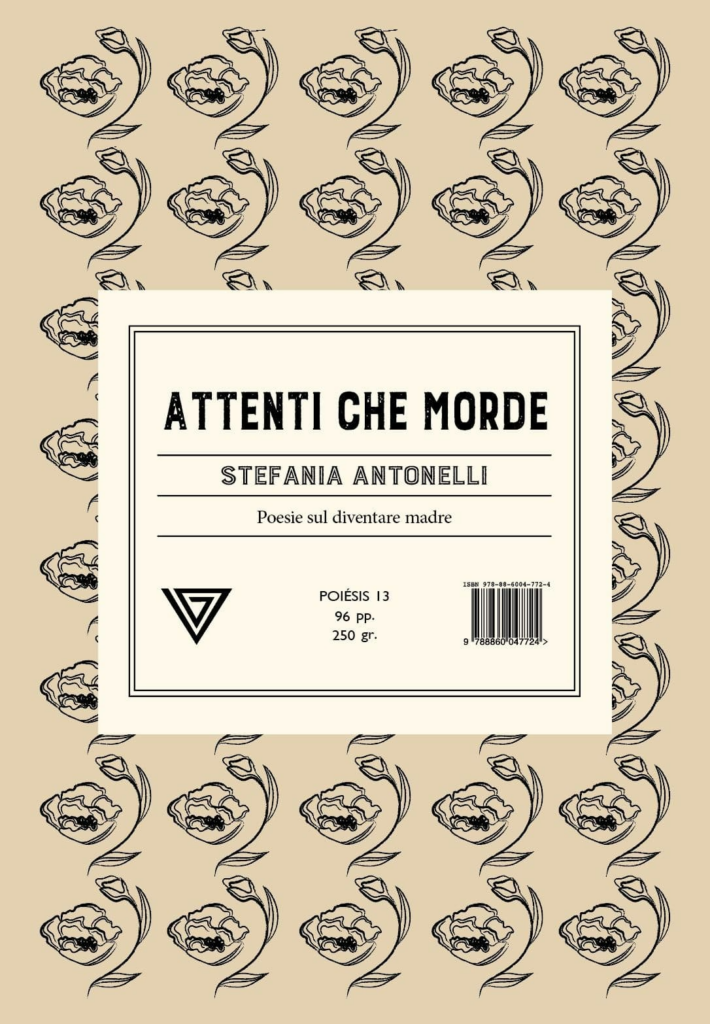
Following these interpretive contextualizations, three poems from Antonelli’s 2025 collection Attenti che morde – Poesie sul diventare madre (Careful, It Bites – Poems on Becoming a Mother) are presented. These poems offer a vivid and compelling glimpse into the lived and written reality of becoming a mother, characterized by its raw, fragmented, intimate, corporeal, and politically resonant nature.
Bone
Noted:
cumin stench all through the house
(it’s the Thai rice I burned in the pan)
dirty hair clumped in strands
crumbs nesting in the corners
cream-slick fingers
at the center of the screen
and then: the compost bag spilling over
as does my urge
to scrub myself
with turpentine, kerosene
and bleach
until nothing remains of me
but a single bone
translucent
tinged with pine
laundry hung and lemon
— but:
it clings to me
the smell of milk
diapers and sweat.
it’s a sign that screams #postpartum
BEWARE: it bites.
Breast
10:27
Note
Quickly open the note on the phone
write without spaces without punctuation breast still out of the
stretched tank top from all the times you latch her on
and she leaves saliva like glue stick like the back of an envelope
to be sealed with a swipe of tongue. I write or rather type
a poem climbing stairs, and with the other hand
I hold your bald head your round skull the ears
crumpled against me period.
Place
I wake and wonder: where am I?
I’m in the place
where mothers dwell.
Works Cited
Alaimo, S. (2010). Bodily natures: science, environment, and the material self. Indiana University Press
Antonelli, S. (2025). Attenti che morde – Poesie sul diventare madre. Giulio Perrone Editore.
Baraitser, L. (2008). Maternal encounters: The ethics of interruption. Routledge.
Bennett, E. A., & Koelsch, L. E. (2022). “I needed to become a mother”: Poetic representations of maternal embodiment, autonomy, and birth trauma. The Qualitative Report 27 (3), 731-743.
Blackwood, S. (2018). Is motherhood a genre? BLARB. https://blog.lareviewofbooks.org/essays/motherhood-genre/.
Braun, A. (2025). Motherhood and creativity in contemporary self-life writing: Writers and mothers. Routledge.
Kristeva, J. (1985). Stabat Mater. Poetics Today, 6 (1-2), 133-152.
Podnieks, E., & O’Reilly, A. (Eds.). (2010). Textual mothers, maternal texts: Motherhood in contemporary women’s literatures. Wilfrid Laurier University Press.
Maushart, S. (1999). The Mask of motherhood: How becoming a mother changes everything and why we pretend it doesn’t. The New Press.