Book Review & Interview
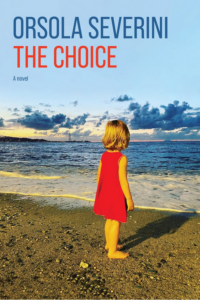
The Choice (2025) and a Conversation with Orsola Severini
Review and Interview by
Julia Campisi
York University
| Funding: No funding was received for this research and publication. Conflicts of Interest: The author declared no conflicts of interest. Review History: Received: 20 November, 2025. Published: 28 June 2026. Copyright: © 2026 by the author/s. License: Critical Gender Studies Network (CGSN), India. Distributed under the terms and conditions of the Creative Commons Attribution (CC BY) license (https://creativecommons.org/licenses/by/4.0/). Published by: Critical Gender Studies Network (CGSN) Citation: Campisi, J. (2026). The Choice (2025) and a Conversation with Orsola Severini. Critical Gender Studies Journal. 3:1. DOI: https://doi.org/10.21659/cgsj.v3n1.08r |
My son will be at daycare for another four hours- enough time, I thought, to read the first half of Orsola Severini’s The Choice. I sat down, hesitant at first, expecting another clinical account of motherhood. In the first chapters, Severini’s prose verges on the clinical, but beneath it an emotional current pulse. I couldn’t stop reading. The micro-gestures between Orsola and Marco, her partner, the unspoken negotiations, the everyday monotony, and the medical jargon you have never heard before mirrored my own experience of becoming a mother. The safe space that Orsola was creating for me within her chapters was deeply vulnerable, relatable, and at times acted as a form of care for my emotions. She resisted simplification and moved between emotions in the most realistic way a mother does. Motherhood, I’ve learned, is a deep experience, one that defies any singular script or preconceived sense or understanding. It was within the pages of this book that I realized that this is the power of motherhood, not its weakness.
Like most women, much of what I experienced during my pregnancy was endured in silence. The first three months of pregnancy are marked by secrecy, that “just in case” period. Reading The Choice brought me back to that moment before my own 20-week anatomy scan, or in the Italian context, the nuchal translucency ultrasound. It’s strange, even cruel, that we are told to announce a pregnancy before this scan, the very one that could demand an impossible decision about your body, your baby, your family. I’ve always found that contradiction absurd, as if silence were protection. But The Choice made me realize how these contradictions are structural or, more specifically, as Veronica Frigeni mentions in the preface, vitapolitical: “a biopolitical framework that does not empower women but entraps them within an imagined natural order, where motherhood is idealized and reproductive choices are policed” (Severini,2025, 5). Severini writes within this tension, showing how nonsense can become the only sense that society allows. This cultural practice, intended as caution, becomes one of many invisible burdens women carry. It’s here that The Choice resonates most powerfully: in the agency Severini reclaims, not only for herself but for all women. She is inviting us to rethink the maternal not as a fixed identity but as an ethical and temporal condition, one marked by negotiation, interruption, and endurance.
In this sense, Severini’s text aligns with Adriana Cavarero’s notion of the inclined subject, a figure defined not by autonomy but by relational exposure and care (Cavarero, 2016). The maternal body, for Cavarero, reveals an ethics of inclination, of being turned toward another. Severini enacts this inclination through form: her narrative bends repeatedly toward her children and her father, refusing the linearity of self-contained subjecthood. Even in her most painful moments, her thoughts remain tethered to others, already in debt to care before caring for herself. Severini moves back and forth between the past (her father) and the present (her pregnancy and loss). At first, these chapters may feel disjointed, but through the lens of scholar Lisa Baraitser, the chapters read as temporal returns, constitutive loops of maternal time rather than digressions. Baraitser examines the relationship between reproductive and non-reproductive time, asking how maternal time might be rethought through repetition, suspension, and forms of time that refuse to flow (Baraitser, 2014). Applied to Severini’s writing, her father’s memories resurface at moments of crisis, not as simple repetition but as shifting rhythmic pulses that sustain her when time and she herself seem to collapse. For me, they became brief reprieves from the present, a slipping, so to speak, in and out of the narrative like consciousness under anesthesia. The recollections work as a way for her, a way to survive these intrusive moments that she is being forced to face alone. These oscillations are not nostalgic but anchoring; they let her endure when there is no time left in which to wait it out.
As I finished The Choice, I thought of Anne Carson’s Lecture on The History of Skywriting, where she remarks that “being the sky requires a fair amount of just hanging there” (Louisiana Channel, 2019). Severini’s memoir feels like that kind of suspension—maintained in time rather than driven by it, a record of care that endures through returns and interruptions. Within this rhythm, The Choice exposes the limits of the neoliberal fantasy of “choice,” revealing endurance as a site of both constraint and resistance. It shows how the maternal body becomes a surface where biopolitical forces are inscribed and continually rewritten (Baraitser, 2014), and how subjectivity inclines toward others as a temporal as much as an ethical condition (Cavarero, 2016). And still, beneath governance and discourse, one image persists: a heart forming within your own, beating inside your body before it walks the world—the pulse of maternal time.
A Conversation with Orsola Severini
JC: Lisa Baraitser writes that “repetition is linked with the radicality of care.” Your book often returns to gestures of care—feeding, touching, waiting, watching. Do you see these repetitions as a form of resistance or as evidence of the exhaustion care can produce?
OS: If I understand the question correctly, I would say that in moments of shock and emotional rupture, we often experience a kind of split within ourselves. That was certainly true for me. On one hand, I had to appeal to my rational side (to decide to terminate the pregnancy, knowing it was the most loving and necessary choice). On the other hand, I was still gripped by instinct: I spoke to the baby, I caressed my belly (automatically, almost unconsciously) because I felt the need to protect him. These gestures are deeply embedded in us, and they can be comforting, grounding (in the book, my mother cares for me mostly through those gestures and by taking care of children for me), while my father manages to communicate, for example, when we cook together.
But care can also become a trap. Especially in the early stages of motherhood, these repetitive gestures (feeding, soothing, enduring) can isolate women, imprison them in routines that generate exhaustion or even distress. So yes, repetition can be radical, but it can also be ambivalent. It holds both resistance and risk.
JC: The book exposes how “choice” in motherhood is never fully autonomous, always entangled with institutions, medicine, and culture. How do you understand choice now, after having lived through and written about it? Has anything changed in the Italian system?
OS: When I found myself in that situation, I was completely unprepared. I had no idea how difficult it would be to access a therapeutic abortion in Italy. I thought the decision would be dramatic only because I was ending a much-wanted pregnancy, and it was. But it also felt, at the time, like the only logical thing to do to minimize suffering for everyone involved, starting with the unborn child. It was, for me, a choice rooted in love.
What I didn’t realize then, and what I came to understand through living it and writing about it, is that this decision or “choice” is, in fact, deeply political. Especially the act of speaking about it publicly. That, for me, is the choice I most fiercely claim: the decision to break the silence around an act of love that thousands of women in Italy are forced to endure in secrecy and shame.
Unfortunately, the situation in Italy has not improved. Even though abortion has been legal since 1978, around 80% of public healthcare providers refuse to perform abortions, citing conscience objections. So, while the law exists on paper, access is increasingly denied in practice, especially in the South of the country.
JC: You capture the isolation of early pregnancy—the “just in case” silence. Why do you think secrecy still dominates the early months of gestation? Did writing this book feel like translating it or breaking that silence?
OS: I lived the early stages of my pregnancies with enormous stress: constantly afraid that my body might betray me, that I wouldn’t be “able” to hold onto the baby. There’s a latent sense of guilt (like in many aspects of women’s lives) that underlies this fear, as if any complication might be your fault. And when that guilt is combined with secrecy, it creates a profoundly delicate and solitary phase in a woman’s life.
That silence is so deeply ingrained that we’re told not to share the news too early, as if grief should be hidden, and we would have the right to grieve the loss of such a loss (there is no ritual in our society for that). I really wanted to translate it into something that could be shared. I wanted to give voice to that fragile, invisible time, and to the many women who live it in fear and solitude, because nobody had told about it before, and everything about motherhood felt so performative.
JC: Your prose moves between clinical description and lyrical intimacy. Was that duality intentional? How did you navigate the tension between medical language and personal embodiment?
OS: Yes, that duality was absolutely intentional and, for me, necessary. I wanted the reader to feel both the coldness of the medical system and the raw, intimate reality of the individual experiencing it. Medical language can be distancing, even dehumanizing, but it also has a crucial function: it is precise, non-judgmental, and allows us to describe what happens to the female body in situations that are often shrouded in silence or shame.
I believe that when the female body is not sexualized, we know very little about it (especially in terms of physical processes like miscarriage, therapeutic abortion, postpartum recovery, and breastfeeding). I think narratives (and things are thankfully starting to change) must also focus on this dimension, and we cannot reduce these experiences to moral or ethical debates alone, because doing so shifts the focus away from the actual problem: the body and how the body connects to the psychological, the social, or the religious spheres.
In addition, I tried to use the duality of language to mirror the duality of the book’s structure. On one side, there is the political dimension (what happens to a woman, any woman, who seeks therapeutic abortion in Italy, the systemic obstacles, the institutional silence, etc.). On the other hand, there is the personal dimension, because trauma is never abstract. We each process it through the lens of our own history. In my case, that meant confronting an unresolved relationship with my father, an eccentric doctor who had fought for abortion rights in the 1970s but was absent when I needed him most.
JC: Your decision to write The Choice transforms an intensely private experience into a public act of reflection and care. How did you navigate that threshold between the private and the shared, between what to protect and what to make visible?
OS: I wrote The Choice in a state of urgency. I often say that I “vomited” the story onto my computer because I needed to speak, and yet I couldn’t find the space to do so. Everyone around me told me to move on, to focus on my “beautiful family”, as if that child wasn’t a part of it. That silence was unbearable. Writing became the only place where I could acknowledge him, where I could say: he existed, and I am his mother.
At first, I didn’t think it would become a book. But then I realized that what had happened to me had happened to many others, and yet I wasn’t hearing those stories. Finding a publisher was difficult. Some suggested I remove the entire section about abortion and focus only on my father, which felt both paradoxical and ironic. Eventually, I found a courageous publisher who asked if I wanted to change my name and references to preserve anonymity. But if I was going to tell my story, I had to go all the way. Otherwise, I would be contradicting the very intention behind the book, to break the silence, not to mask it. Of course, I changed the names of others involved, out of respect for their privacy. But the story is mine, and I claim it fully.
JC: Much of The Choice is grounded in Rome and Italian social norms. How do you think your story might have unfolded differently within another cultural or legal system—say, in Canada or Northern Europe?
OS: I’m quite certain that, practically speaking, things would have been easier. In countries like Canada or parts of Northern Europe, I likely would have encountered fewer institutional obstacles, more consistent medical support, and perhaps less stigma, and the whole process might have been smoother, more humane. But on a personal level, I believe the emotional experience (the grief, the ambivalence, the inner conflict) would have been very similar. Because those dimensions are not only shaped by external systems, but also by our histories, our relationships, our sense of self.
At the same time, I’m genuinely curious to hear how women in other countries live these experiences. I hope the book can open a space for dialogue across borders. While the Italian situation is particularly dramatic, the right for women to control their bodies is under threat throughout the West. The U.S. Supreme Court’s decision a few years ago is a stark reminder of how fragile these rights are. That’s why I believe it’s essential for women to connect beyond national boundaries; in a globalized and interconnected world, reproductive justice must also be a global conversation.
JC: Was there a certain way that you felt like you had to grieve the loss of your baby differently from the loss of your father? When people die, the ceremony is so important for those still living – it gives closure. It seems like a lot of families don’t get that sort of same closure with the death of their unborn babies. I think most of this has to do with the fact that a lot of these “miscarriages” or “therapeutic” abortions still happen in silence. What is your take on this?
OS: You’re absolutely right. When my father died, there was a funeral, a gathering, food, and stories. There was “il consolo” (a Southern Italian tradition of bringing comfort through presence and nourishment). But when I lost my baby, there was nothing. No ritual, no recognition. Just silence or urges to change the subject. That absence was devastating. Writing became my ritual. It was how I mourned, how I made sense of the loss, how I created a space for memory. I believe we need new rituals, ones that honor these invisible griefs and allow families to process them with dignity, and women sharing their experiences could be a very good one.
JC: Now that The Choice is out in the world, has your relationship to the story changed? Do you still feel inside its temporality, or has time finally begun to move differently?
OS: Time has shifted, but the story still lives in me. Publishing the book allowed me to place the experience outside of myself: to give it form, voice, and distance. But I still carry it. I always will. That child existed. I am his mother. And that bond doesn’t dissolve with time. What has changed is that now, when I speak about it, I feel less alone.
One of the most unexpected outcomes was how my father (who had been a real, complex presence in my life) became a character. That’s a strange experience. I’m not always sure where memory ends and narrative begins, or how much of him I’m remembering versus how much I’m reimagining through storytelling.
JC: Have you ever considered sharing the letter you wrote to your mother?
OS: My mother is an extremely private person. In the first version of the manuscript, I had written more about but she asked me to remove those parts, and I had to respect that. What remains in the book is essential and true, but carefully measured. As for the letter my father wrote to her, she never let me read it. So yes, we’re two curious women wondering what it contains.
Bibliography
Baraitser, L. (2014) “Time and Again: Repetition, Maternity and the Non-Reproductive”, Studies in the Maternal 6(1), 1-7. doi: https://doi.org/10.16995/sim.3
Louisiana Channel. (2019, March 13). Anne Carson: Lecture on the history of skywriting [Video]. YouTube. https://www.youtube.com/watch?v=9F9xUhaimTY
Cavarero, A. (2016). Inclinations: A critique of rectitude (A. Wilson, Trans.). Stanford University Press. (Original work published 2014)